As promised, here’s a blog post about my piece titled “Can You Hear Me Now? Bok.”
If you haven’t already, I recommend you read the first article I wrote about this project before continuing.
I had a few goals for this project:
- All of the chickens must still squeak
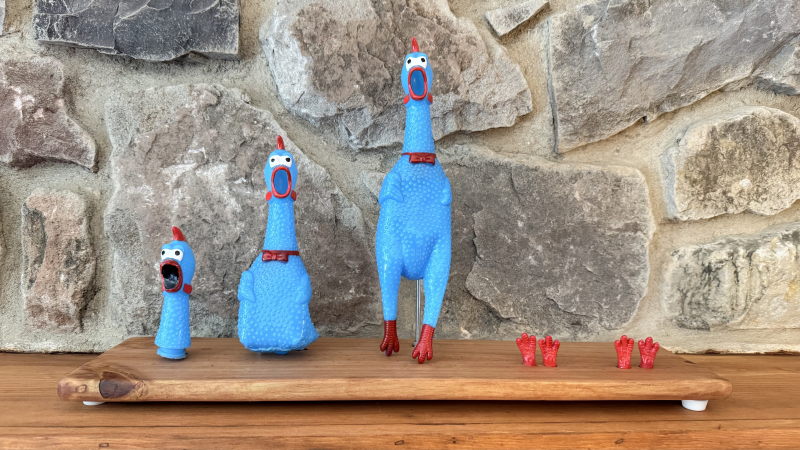
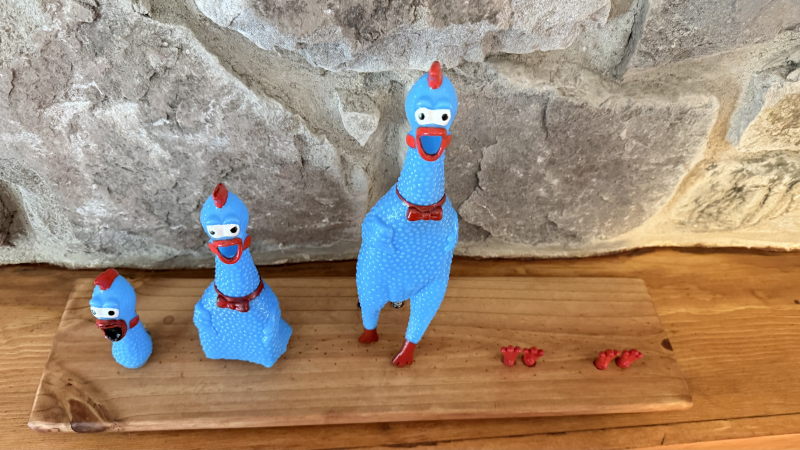
- The chickens must be presented as three tiers, held upright on a base
- The piece is intended to be vaguely reminiscent of mobile phone signal strength bars
Meet the cast!
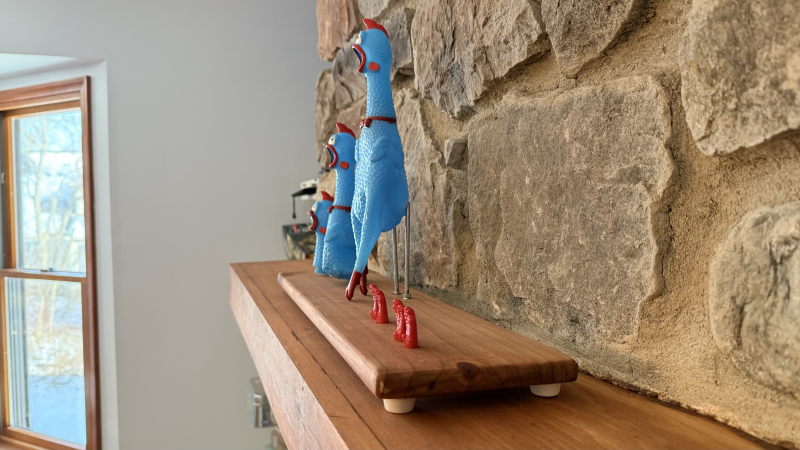
We have three rubber chickens on the piece. Starting from the left, we have he “just a head” chicken. To its right is the “truncated” chicken, which then has to its right a full and unmodified chicken. Each of them has had their makeup touched-up, as factory paint was pretty poor. Additionally, there are two pair of “ghost bars” done with feet.
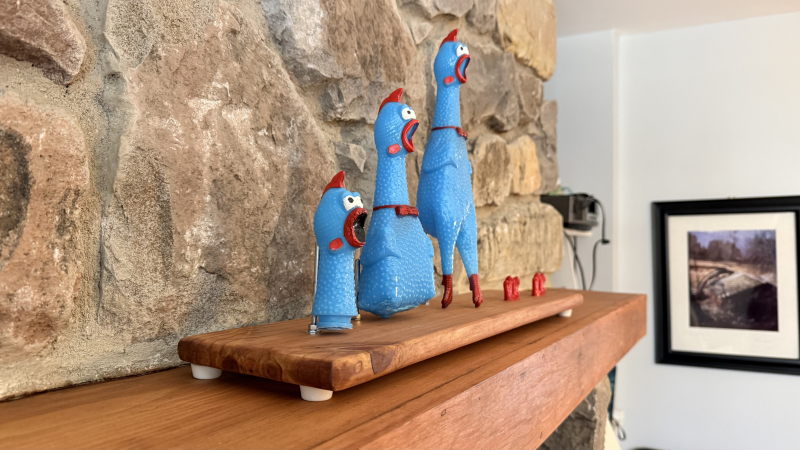
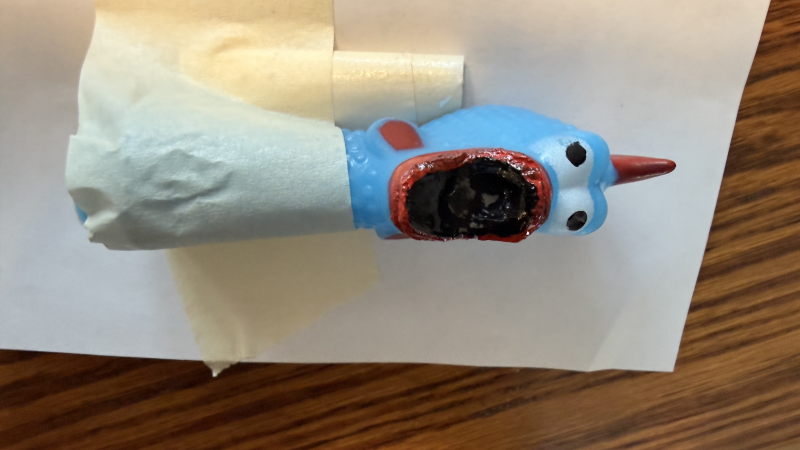
The “just a head” chicken had to have a small flap welded over its mouth in order to allow the whistle to continue working without the bellows of the body attached to it.
Meet the base.
The base is a length of pine 2×6 that I had left over from another project (building a door for the screened-in porch). I sanded it quite a lot, removed a bunch of rough edges, and kinda just made it look like not a cheap piece of pine. It had a twist in it, too, which I had to account for on the rubber feet.
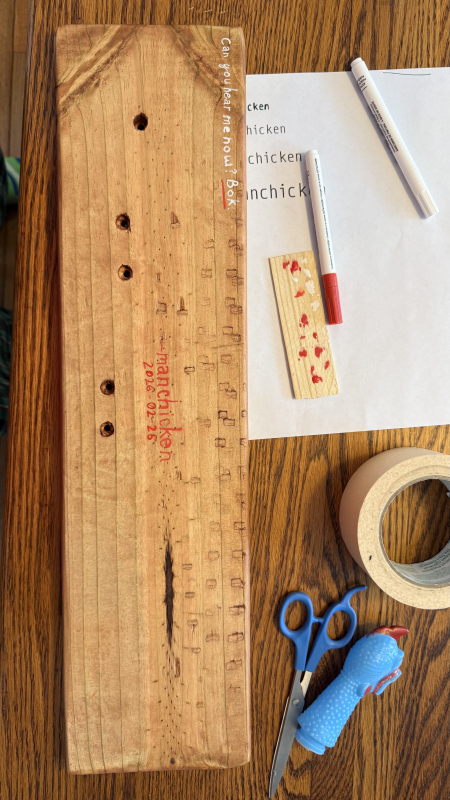
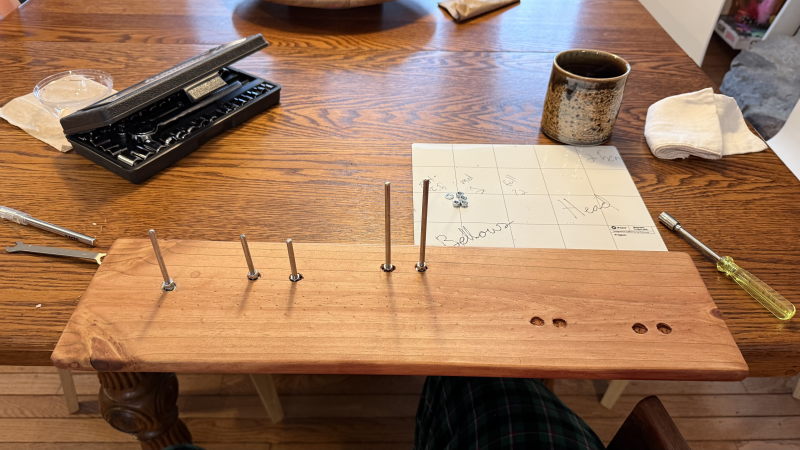
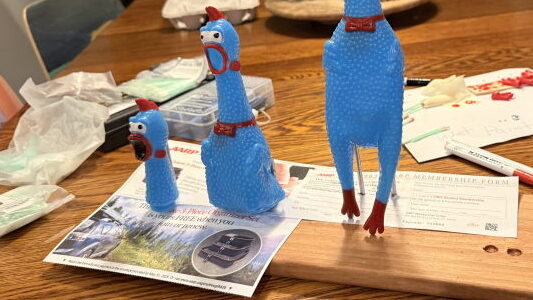
The base has 3/16″ steel rods that I threaded M5 on one end and bolted into the base using locking nuts and washers. I then super-glued the chickens to those rods in this lovely configuration.
Experimentation
I’m not exactly what you’d call an “experienced artist,” I’m quite literally just hacking this together as I go; this is hacker art, after all. There are some rough edges around this work, but it is still meant to be taken seriously as “art.” Naturally, experimentation is part of my creative process, and so I’ll share two of my experiments with you. One went well, and the other one: not so much.
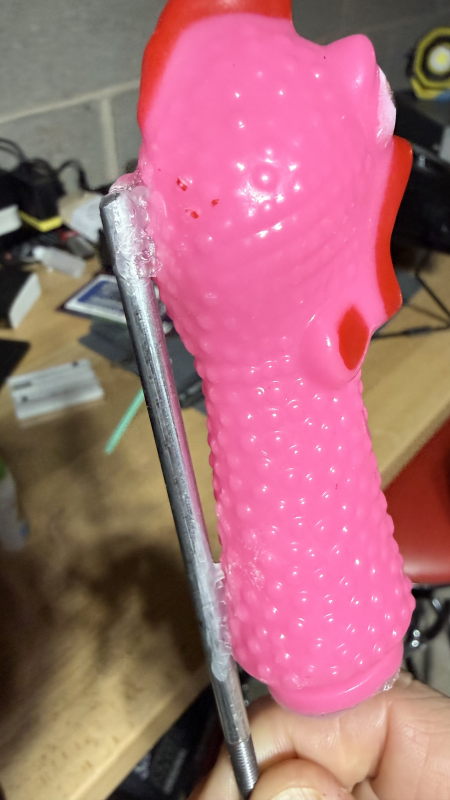
On the left we have a pink rubber chicken head. You can see that it is fully attached to the steel rod (you can kinda make out the threading on the rod near my thumb. This experiment was intended to help me determine whether or not I would be able to use Gorilla Super Gel on the chicken to get it to stick to the rod. I was especially looking for weak or brittle joints, as well as damage done to the chicken as the glue reacts with the vinyl. This experiment was a wild success, the glue worked well and the joints were pretty solid. I was able to make the chicken head squeak just fine.
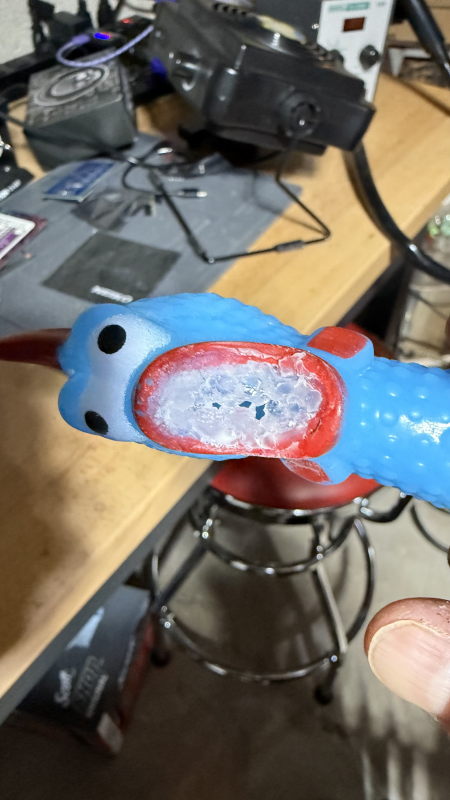
The second experiment, on the right, did not go so well. In working with Gorilla Super Gel, I’ve managed to get away with simply building up a wall of glue to cover a hole or fill in a gap, and I thought I’d be able to get away with it here as well. The plan was to build a wall of glue and then paint it black, and that plan failed miserably. In addition to the difficulties in getting the glue to cure, I noticed that every time I tried to squeeze the chicken a fissure opened up in the wall of glue allowing air to escape. This meant that whenever I tried to squeeze the chicken head no sound came out. More than that, because the glue wouldn’t cure I had a lot of glue that oozed out every time I tried.
First I cleaned out all of the old glue (took longer than you think, some had fallen inside the cavity) and then I had to double-back on the chicken head, and weld a piece of vinyl from the portion truncated for the middle chicken on the finished piece over the mouth of the chicken. This then needed to be painted black (was blue). While I was painting this, I noticed that the red I was using was a different shade, and then upon further examination I determined that I kinda hated the factory paint.
Painting
I painted the eyes, combs, and mouths of the chickens using acrylic paint markers. I also painted the feet red. I thought about painting the bow ties, but decided against it since there were too many tiny valleys in them where I couldn’t fit my paint marker tip, and the bow ties also looks fine.
Lessons learned
The first lesson I learned is, obviously, not to spill wood stain. From there, I learned that even if you suck with a tap-and-die, you can still make usable threads on a steel rod. My threads were pretty rough, and I got metal shavings everywhere (that was an hour of my life with a magnet and a dust buster that I’ll never get back!), but they did work. The locking nut approach (two nuts right next to each other tightened into one another) worked, but I discovered later that I have threaded nuts that will screw into the wood and let you just unscrew the rods. It would have required me to reconfigure the rods in order to use them, but I would have liked to try it out but I was already too far down the path I was on.
I learned that it’s always good to mask off areas you’re not working on to protect them. While I was experimenting with a pink rubber chicken head, making sure that it would still be squeezable without a fragile joint, I lost one drip of super glue. That one drip of superglue landed on my forearm, and that helped me think through how I was going to install the chickens on the rods. I knew I wanted the rods to be installed in the base when I glued the chickens to them, that way I would have them lined up perfectly, but I didn’t want to get any errant super glue on the base. I just snatched some AARP solicitations from that morning’s newspaper (yes, I still read a physical newspaper) and used them to protect the wood.
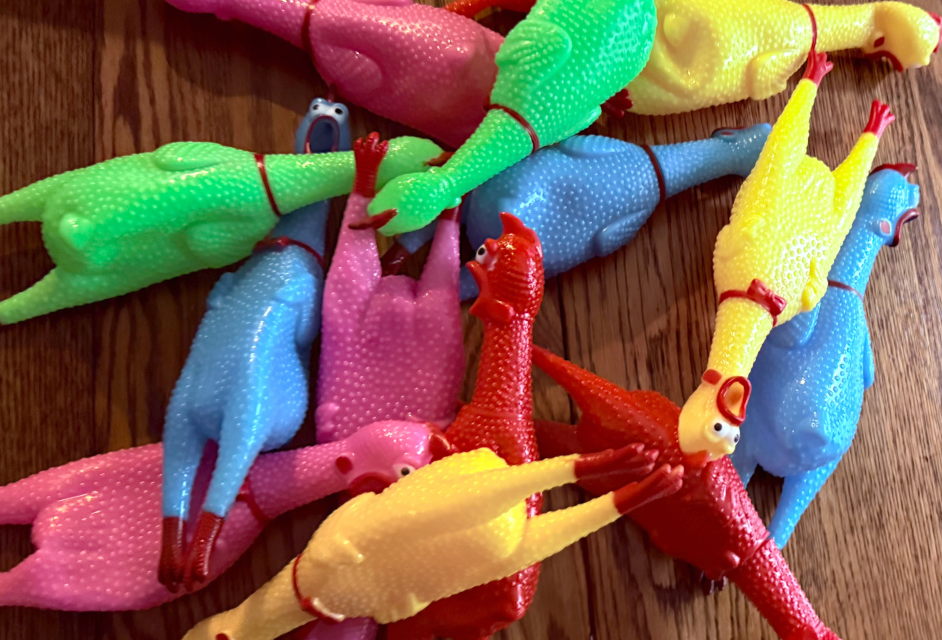
I learned that it’s always good to have stand-ins when you’re experimenting with new techniques. As I said in the prior post, I have a bunch of rubber chickens in a variety of colors. I knew I wanted to use the blue ones for this since blue is a common color for signal strength bars, so I used one pink rubber chicken as my test dummy when I tried out new techniques.
It’s done!
So that’s it; that’s the art project I’ve been working on.
The primary purpose of this project was to help me process emotions after having been illegally fired by The Washington Post for union participation while bargaining for our first contract, and in that regard I think the project has been a wild success.
More than that, though, this is my first major “work of art” that I have submitted to an art show, and I hope it gets accepted.
Thanks for following along my journey, and I do have other projects I’m working on that I’ll share soon.